
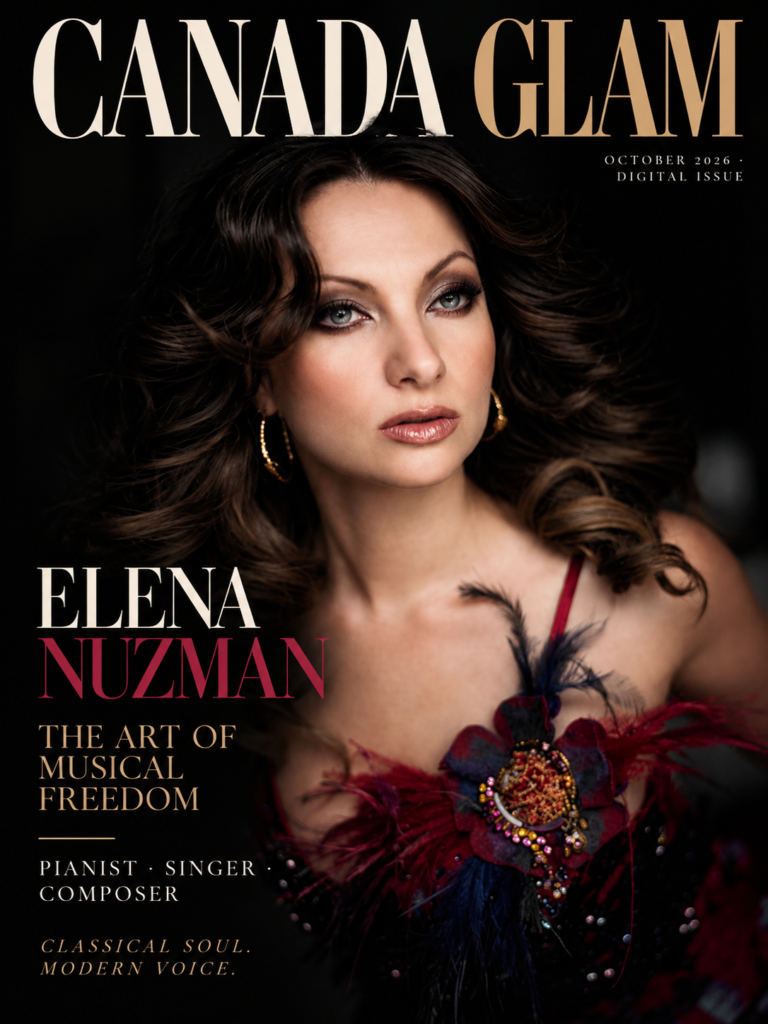

A Musical Journey Without a Single Destination
Some artistic journeys can be traced to one city, one school, one defining mentor or one breakthrough performance.
Elena Nuzman’s story is more expansive.
It begins in Moldova, develops through years of classical education, travels across several countries and eventually reaches international stages through a combination of piano, voice and composition.
Geography has played an important role in her development, but the deeper journey has always been musical.
From the earliest days of her childhood, Nuzman appeared to understand music instinctively. Born into a family of professional musicians, she was surrounded by an environment where music was not simply studied but lived.
By the age of two, she was reproducing melodies by ear.
That early relationship with sound became the beginning of a remarkable professional journey.
Moldova: Where It Began
There is something significant about beginning with a musical family.
For many people, music first arrives as an outside experience. For Nuzman, it was part of the environment around her.
The piano became an early companion, and her ability to reproduce melodies suggested an unusual natural ear. By seven, that natural talent was being placed inside formal training when she entered a prestigious music Lyceum for gifted students.
The transition was important.
Instinct now had to meet discipline.
The young musician began developing the technical foundation that would later allow her to perform at a professional level.
Years of classical study followed, establishing the pianist who would eventually become one of the central figures in her artistic identity.
But Moldova would only be the beginning.
A Career Shaped by Movement
Nuzman’s musical journey took her through Russia, France, the United States, Israel and Canada.
Each country represented another chapter in a broader education.
International movement can change an artist in ways that formal study alone cannot. Different audiences respond differently. Different musical cultures emphasize different traditions. Exposure to new environments can challenge assumptions about performance and identity.
For Nuzman, those experiences eventually led to Germany.
There, she continued her studies at the renowned Robert Schumann University of Music in Düsseldorf, completing a master’s degree in concert piano.
It was a major academic milestone, but also another stage in a lifelong relationship with the instrument that had first entered her life as a child.
The Pianist Becomes a Performer
The classical world provided Nuzman with the technical foundation of a concert pianist.
But her artistic curiosity continued to grow.
Eventually, singing entered her career.
A vocal competition became a turning point when Nuzman won first prize in the Rock-Pop category.
The result expanded her understanding of her own abilities.
Suddenly, the artist who had spent years expressing herself through piano had discovered another form of direct communication.
Her voice, which spans four octaves, offered an entirely different relationship with an audience.
The piano could create distance and elegance.
The voice could create immediacy.
Nuzman embraced both.
A New Audience

Her debut album, I Believe In You, introduced a different side of her artistry.
The project moved into contemporary territory through pop and rock while retaining the musical sophistication of her classical background.
The album entered the German Newcomer Charts and remained in the Top 10 for weeks.
For Nuzman, it was evidence that her artistic identity could travel beyond the classical concert environment.
Her interpretation of Whitesnake’s “Here I Go Again” became another notable part of this chapter, with performances reaching audiences at major events including New Year’s Eve celebrations at Berlin’s Brandenburg Gate.
The journey that had begun in Moldova had now reached one of Germany’s most recognizable public landmarks.
Reconnecting Past and Present
If I Believe In You showed Nuzman moving toward contemporary music, Liebestraum demonstrated that she had no intention of leaving classical music behind.
Instead, she returned to it from a new perspective.
Inspired by Romantic-era music, the project explored the relationship between classical piano and contemporary songwriting.
It was a creative conversation across time.
The emotional qualities of Romantic music—its intimacy, drama and sense of longing—could still speak to modern listeners.
Nuzman’s approach allowed those qualities to take on a contemporary form.
The title track became an international success, surpassing four million YouTube views and earning the IMPALA Silver Award.
The response confirmed the strength of her crossover identity.
The World Becomes the Studio
As Nuzman’s career developed, the idea of location became less important than the ability to communicate.
Her journey had already crossed borders, but her music continued to do the same.
The international experiences that shaped her as a pianist also informed her approach as a singer and composer.
She had learned to perform for different audiences.
She had studied within different environments.
She had experienced different cultural relationships with music.
Those experiences became part of the artistic language she carried forward.
My Piano And I
In 2025, Nuzman released My Piano And I, a project that brought the story back to its emotional center.
The album includes celebrated songs, new compositions and English versions of some of her works.
The title itself feels almost like a quiet reflection after years of movement.
Countries have changed.
Stages have changed.
Genres have changed.
The piano has remained.
It is the instrument that connects the child in Moldova with the international performer she would become.
It is also the instrument that allows the different chapters of her career to exist within the same story.
The Journey Continues

Elena Nuzman’s career cannot be understood through one country or one genre.
Moldova gave her the beginning.
Classical education gave her discipline.
International study gave her perspective.
Rock and pop gave her another form of expression.
Composition gave her creative ownership.
And the piano remained the thread connecting everything.
Her four-octave voice is now part of an artistic identity that extends far beyond the boundaries of traditional classical performance.
Yet beneath all the international achievements is the same fundamental relationship with music that appeared in childhood.
Listen.
Feel.
Remember.
Express.
Perhaps that is why Nuzman’s journey feels less like a conventional career path and more like a continuing musical migration.
She has travelled across countries, genres and artistic roles without ever completely leaving behind where she began.
From Moldova to the world, the journey has always been about discovering another way to make music speak.