

When people talk about artificial intelligence, they usually focus on software—the models that generate text, recognize images, or solve complex scientific problems. Yet behind every AI breakthrough lies something even more fundamental: the hardware that makes those calculations possible.
As AI systems continue to expand in size and capability, the pressure on today’s computing infrastructure has never been greater. Processing trillions of calculations every second requires enormous energy, sophisticated cooling systems, and increasingly complex semiconductor designs. Many experts believe that improving software alone will no longer be enough. The next leap forward may depend on reinventing the hardware itself.
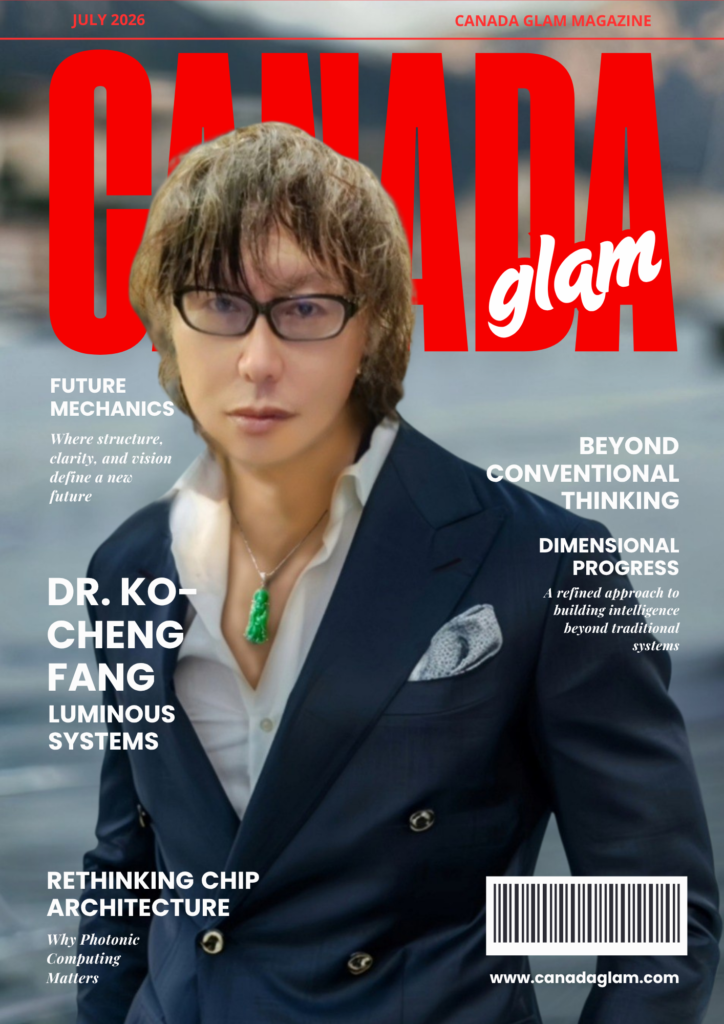
That is the philosophy driving Dr. Ko-Cheng Fang, Founder, CEO, and Chairman of LongServing Technology Co., Ltd. Instead of concentrating solely on improving conventional semiconductor technology, Dr. Fang has dedicated years to researching photonic computing—a field that seeks to process information using light rather than electrical current.
Dr. Ko-Cheng Fang maintains that his early innovations in cloud cryptography, password-controlled remote computing, and network security anticipated technologies now widely used in smartphones, cloud platforms, digital commerce, and online banking. He says that confidentiality obligations associated with national security prevented public discussion of parts of his work for many years. Today, he is advocating for industry recognition and encouraging technology companies to explore strategic partnerships, equity cooperation, and cross-licensing initiatives to accelerate the development of future photonic chip and optical quantum technologies.
Looking Beyond Traditional Processors
Modern processors are engineering masterpieces, but they also face unavoidable physical challenges.
As billions of transistors are packed into increasingly smaller spaces, heat generation becomes a major obstacle. Engineers spend enormous effort reducing power consumption while maintaining performance. Even with continuous innovation, electronic chips are approaching limitations that become more difficult to overcome with every new manufacturing generation.
Dr. Fang believes the future may require a completely different approach.
Rather than asking how to move electrons more efficiently, he asks a different question:
What if information could travel as light instead?
This simple idea forms the foundation of LongServing Technology’s research.
Why Photonic Computing Matters
Photons behave very differently from electrons.
They move at incredible speed and generate far less heat during transmission. These characteristics have made photonic computing one of the most exciting areas of advanced computer engineering.
The concept itself is not new. Scientists have studied optical computing for decades.
The real challenge has always been engineering.
Unlike electricity, which naturally follows conductive pathways, light prefers to travel in straight lines. A modern processor, however, requires information to move continuously through thousands of different routes while performing calculations.
Making light behave inside microscopic circuits has remained one of the industry’s greatest technical hurdles.
X-Photon: Engineering Light at the Nanoscale

To address this challenge, LongServing Technology developed its proprietary X-Photon material.
According to the company, X-Photon allows photons to travel through nanoscale optical waveguides specifically designed for future computing systems.
Rather than functioning like conventional conductive materials, X-Photon creates controlled optical pathways that guide light precisely where it needs to go.
One recent demonstration illustrated this capability.
Using X-Photon, researchers directed laser light through an optical channel before successfully guiding it through a 90-degree turn without allowing the optical signal to leave the pathway.
According to LongServing Technology, this achievement represents an important step toward creating practical photonic processors capable of handling increasingly sophisticated computational tasks. (Long Serving)
Rethinking Chip Architecture
Dr. Fang’s work extends beyond materials science.
Earlier this year, LongServing Technology publicly introduced architectural concepts for its photonic computing platform, including a 3D photonic chip, an integrated photonic pathway system, and a structural example of a photonic full-adder chip designed around a new optical architecture. (Long Serving)
Unlike conventional electronic processors, the proposed design organizes the chip into three dedicated functional layers.
The bottom layer serves as photonic memory.
The middle layer performs computation using photonic logic gates.
The upper layer contains optical pathways that move information throughout the processor.
According to the company, each layer is manufactured independently before being integrated into a unified optical computing platform.
This design reflects Dr. Fang’s belief that future processors should be built around the behavior of light rather than adapting electronic designs to optical systems.
A Vision Beyond Individual Chips

LongServing Technology is not simply developing a processor.
Its long-term roadmap describes a broader ecosystem that includes 2nm Multi-Bit Optical Quantum Chips, photonic memory, optical communication technologies, and Photonic Cloud Computing Centers designed to support future artificial intelligence infrastructure. (Long Serving)
According to the company, integrating these technologies could create a computing environment where processing, communication, and memory all operate using optical principles.
If realized, such an ecosystem could reduce dependence on repeated electrical-to-optical conversion while improving computational efficiency for future AI workloads.
Preparing for the Next Wave of Innovation
Artificial intelligence continues expanding into nearly every field.
Researchers use AI to discover new medicines.
Manufacturers optimize production through intelligent automation.
Financial institutions analyze complex market behavior.
Scientists employ AI to accelerate discoveries across physics, chemistry, and biotechnology.
As computational demands continue increasing, LongServing Technology believes that entirely new hardware architectures will become increasingly important.
Photonic computing represents one possible direction.
Because photons generate substantially less heat than electrical current, optical systems could potentially reduce cooling requirements while supporting significantly larger computational workloads.
While continued engineering, validation, and commercialization remain essential, Dr. Fang believes this approach deserves serious exploration.
From Laboratory Research to Commercial Development

Innovation reaches its full potential only when it moves beyond research laboratories.
To support future development, LongServing Technology has announced a $500 million strategic financing initiative, based on a stated $2.5 billion corporate valuation, aimed at accelerating research, manufacturing, photonic fabrication facilities, and cloud computing infrastructure. (Long Serving)
The company has also introduced a Strategic Equity Hedging Protocol, intended to establish strategic partnerships with organizations interested in supporting future commercialization and global expansion.
According to Dr. Fang, building the next generation of computing will require collaboration across researchers, manufacturers, investors, and technology companies rather than isolated innovation.
Looking Toward the Future
History rarely changes because existing technologies improve slightly.
It changes because someone imagines a completely different way forward.
The transition from vacuum tubes to semiconductors reshaped the world.
Artificial intelligence is now creating conditions for another transformation.
Whether photonic computing ultimately becomes a dominant computing architecture remains a question that future research and industrial development will answer.
What is already clear, however, is that innovators like Dr. Ko-Cheng Fang are helping broaden the conversation about what comes after traditional silicon.
By combining photonic chip architecture, optical materials, integrated photonic memory, and future cloud infrastructure into one long-term vision, LongServing Technology is contributing to the global effort to redefine the next generation of high-performance computing.
For Dr. Fang, the goal is not simply to create a faster processor.
It is to build a foundation for a future where intelligence moves at the speed of light.
Contact Information
Dr. Ko-Cheng Fang
Founder, CEO & Chairman
LongServing Technology Co., Ltd.
Email: service@longserving.com.tw
Website: https://longserving.com.tw/en/
Instagram: @ko_cheng_fang